Metagenomics
Learning Outcomes
After successfully completing the lectures and laboratory exercises of the course, postgraduate students will be able to:
Knowledge and understanding
- evaluate computational, bioinformatics, and machine learning approaches used for the design, modelling and optimization of biological systems.
- understand the interdependence between molecular composition and function at the level of cellular structures
- design and evaluate metagenomic experimental strategies, including DNA extraction approaches, cell/DNA enrichment methods, sequencing depth and platform selection, method selection for functional metagenomics
- critically assess functional metagenomics library construction and activity-based screening methods, and propose Synthetic Biology solutions to heterologous gene expression challenges
- integrate metagenomic findings within a Synthetic Biology framework, linking environmental DNA blueprints to pathway engineering and biosynthetic potential
Skills
- execute bioinformatics pipelines for metagenomic data processing, including read QA/QC, metagenome assembly, binning to MAGs, quality assessment, and taxonomic/functional annotation
- apply annotation strategies and database searches to characterize the functional potential of complex microbial communities, including gene cluster and metabolic pathway prediction
- predict and evaluate protein structures and perform docking analyses of novel enzymes discovered through metagenomic mining
Competencies
- design and independently conduct research projects in synthetic biology, applying modern experimental, computational, and automated methodologies.
- critically evaluate the scientific literature and integrate new research findings into the design of biological systems.
- make informed decisions when addressing complex and unpredictable research or technological challenges.
- collaborate effectively within interdisciplinary teams combining biology, engineering, computer science, and chemistry.
- communicate scientific results and technological applications effectively to both specialist and non-specialist audiences.
Module Syllabus
Theory
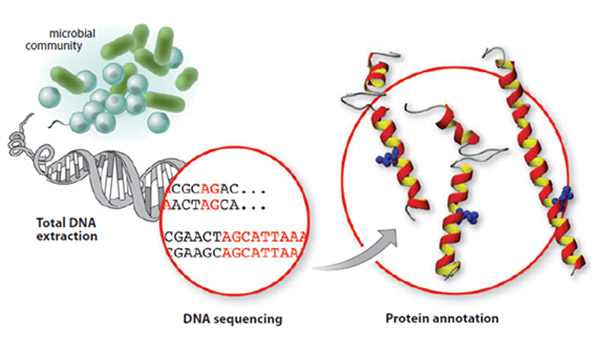
- Introduction to Metagenomics: brief history and key questions; sequence-based vs functional metagenomics and relevance to Synthetic Biology; levels of analysis (shotgun vs targeted enrichment); experimental designs; DNA extraction approaches and cell/DNA enrichment methods
- Sequence-based Metagenomics I: sequencing platforms and detection limits; read QA and QC; metagenome coverage and data analysis strategies; read mapping vs assemblies; universal vs gene-centric assemblies; sequence assembly; metagenome binning to MAGs and quality assessment
- Sequence-based Metagenomics II: read and assembled sequence annotation strategies (k-mer vs local alignment; gene prediction and functional annotation); universal vs thematic database annotation; gene clusters and metabolic pathway prediction; statistical and comparative analysis; structural prediction and docking of novel enzymes
- Functional Metagenomics: library construction principles (DNA extraction, insert size, vector type, host choice for heterologous expression); library screening methods (colorimetric, fluorigenic, flow cytometry, microtiter plate readers); challenges of heterologous gene expression and Synthetic Biology solutions (genetic code optimization)
Computer Practicals
- Metagenomic data processing: read QA/QC, metagenome assembly, and binning to MAGs using command-line bioinformatics tools
- Functional annotation and comparative metagenomics: annotation pipelines, pathway prediction, and statistical analysis of metagenomic data sets
Suggested Bibliography
- “Metagenomics: Methods and Protocols, 3rd ed” Streit, Wolfgang R. Daniel, Rolf (Eds), 2023. Springer US, New York, NY. ISBN: 978-1-071-62795-2
- “Metagenomics and microbial ecology: techniques and applications” S. d. Mandel, A. Kumari Panda, N. Senthil Kumar, S. Singh Bisht, & F. Jin, (Eds), 2022. CRC Press, Taylor & Francis Group.
- “The New Science of Meatagenomcis: Revealing the Secrets of Our Microbial Planet”, Committee and staff on Metagenomics, National Academies Press, 2007. ISBN: 0-309-10677-X
- Course Lecture Notes and Computational Laboratory Tutorials (available on the e-class platform)
- Bharti, R. and Grimm, D.G. 2019. Current challenges and best-practice protocols for microbiome analysis. Brief. Bioinform. 22(1), 178-193.
- Kunin, V., Copeland, A., Lapidus, A., Mavromatis, K. and Hugenholtz, P. 2008. A bioinformatician’s guide to metagenomics. Microbiol Mol Biol Rev 72(4), 557-578, Table of Contents.
- Ma, F., Guo, T., Zhang, Y., Bai, X., Li, C., Lu, Z., Deng, X., Li, D., Kurabayashi, K. and Yang, G.-y. 2021. An ultrahigh-throughput screening platform based on flow cytometric droplet sorting for mining novel enzymes from metagenomic libraries. Environ. Microbiol. 23(2), 996-1008.
- Quince, C., Walker, A.W., Simpson, J.T., Loman, N.J. and Segata, N. 2017. Shotgun metagenomics, from sampling to analysis. Nat. Biotechnol. 35(9), 833-844.
- Robinson, S.L., Piel, J. and Sunagawa, S. 2021. A roadmap for metagenomic enzyme discovery. Nat. Prod. Rep. 38(11), 1994-2023.
- Uchiyama, T. and Watanabe, K. 2008. Substrate-induced gene expression (SIGEX) screening of metagenome libraries. Nature Protocols 3(7), 1202-1212.
- Valmas, M.I., Kormas, K., Karpouzas, D.G., Konstantinidis, K.T., Rozman, S.D., Udiković-Kolić, N., Remus-Emsermann, M.N.P. and Vasileiadis, S. 2025. Targeted analysis of metagenomes: divide and conquer. Biotechnol. Adv., 108619.